Mostrando postagens com marcador safety. Mostrar todas as postagens

domingo, 1 de janeiro de 2023

WAS IT A FLARE ACCIDENT OR LANDING ACCIDENT?


INVESTIGATION MUST REPORT IF THE ACCIDENT WAS A LANDING ACCIDENT OR A FLARE ACCIDENT


Mastering the Landing Flare/Round out

Pilot Perception

Analysis of 6,676 aircraft accident reports published by the National Transportation Safety Board

134 pilots with varying experience levels

Sources:

  •           THE INTERNATIONAL JOURNAL OF AVIATION PSYCHOLOGY, 12(2), 137–152
  •      Oklahoma State University
  •      Department of Psychology
  •      Laboratory of Comparative and  Behavioral Biology

           Danny Benbassat and Charles I. Abramson

  •  Razia Rashid - founder of Psychology To Safety
  •  ATSB RESEARCH AND ANALYSIS REPORT
  • Aviation Safety Research Grant – B2005/0119

Aerial perspective is a monocular cue which is used for depth perception [the atmosphere causes distant objects to look hazy or blurry], which is used to judge how far away objects are. Monocular cues are named because they can occur only using one eye (as opposed to binocular cues which only occur with the use of both eyes).

Critical perceived time to contact (TTC)


Time remaining until the aircraft’s wheels make contact with the runway if no further action is taken (Mulder et al 2000).

TTC must be estimated directly, without first estimating speed and distance, based on the following ratio (known as tau):

TTC ≈ θ/(dθ/dt)

Where θ is the visual angle between the aimpoint and any other point on the ground plane at time one (see Figure above); and dθ/dt is the rate of change of this angle over time (Hoyle F 1957; Kaiser & Mowafy 1993; Lee, DN 1976).

Tau is a monocular cue to time-to-contact. During a landing, tau can be defined as the ratio of the angular distance between any two points on the ground (which happen to lie along the aiming line) divided by how fast this angular distance is increasing. Several other versions of tau have been proposed (see Regan & Gray 2000).

In more recent aviation research, Mulder and colleagues (2000) found mixed support for the proposals that flare timing is based on perceived runway angle (ψ) and perceived TTC (based on tau).

Study

The effects of pilot’s critical flare operation on long and hard landing events based on real flight Quick Access Recorder (QAR) data.

Flare accident rates

Causes for improper flares

The flare is the transition from a controlled descent to actual contact with the landing surface (Federal Aviation Administration [FAA], 1999; Grosz et al., 1995) and is also known as the flare out, round out, or level off (Jeppesen, 1985).

The task of determining the aircraft altitude above ground is crucial to a successful flare (Green, Muir, James, Gradwell, & Green, 1996) and is accomplished by the use of vision more than any other sense (FAA, 1999; Jeppesen, 1985; Menon, 1996; Nagel, 1988; Thom, 1992).

Depth Perception

Depth perception deals with the ability to see the environment in three dimensions and estimate distances of objects from us and from each other.

Aerial Perspective, objects at larger distances from us are affected by natural scattering of light and form less of a contrast with their background; making it harder to gauge a distance between the two and us.


Monocular cues operate when a person is looking with only one eye

 Pilots rely on monocular depth perception cues rather than binocular depth perception cues (Benson, 1999; Bond, Bryan, Rigney, & Warren, 1962; Langewiesche, 1972; Nagel, 1988).

Monocular depth perception is learned or dependent on experience (Benson, 1999; Bramson, 1982; Langewiesche, 1972; Love, 1995; Marieb, 1995; Tredici, 1996).

-          It is used by artists to induce depth in their two dimensional paintings. Thus, they are also called as the pictorial cues.

The monocular cues that help us in judging the depth and distance in two-dimensional surfaces:

·         Linear perspective: Imagine you are standing between the rail tracks and looking in the distance. You would see that the rail track become smaller and smaller, until there is a point where they meet each other. Linear perspective reflects this phenomena. It says that the distant between two objects far away appear to be smaller than what the distance actually is.

·         Interposition or overlapping:  This monocular cue occurs when one object covers the other. The object that is completely visible seems to be nearer and the object that is partially visible seems to be farther away.

·         Clearness: The more clear the object the nearer it seems. For example, on a hazy day a distant mountain would appear far away than on a clear day, because haze blurs the fine details. Therefore, if we see details of an object we perceive it closer.

·         Relative height: We perceive large objects to be closer to us and smaller objects to be farther away.

·         Motion parallax/ Movement: This cue occurs when the objects are in motion. The distant object appears to move slowly than the objects that are close.


Binocular cues operate when both our eyes are working together

Binocular depth perception is innate or acquired very early in life (Fox, Aslin, Shea, & Dumais, 1980; Kalat, 1998; Reading, 1983; Reinecke & Simons, 1974).


The cues that are provided by both the eyes working together:

·         Retinal or binocular disparity: Humans have two eyes which are horizontally separated by a distance of 6.5 centimeters. Because of this distance between two eyes the images formed on retina of a same object is slightly different. This difference in the images of two eyes is retinal disparity.

·         Convergence: when we see a closer object our eyes turn inward or converge, so that the image is formed on the fovea. Some muscles in our eyes send signal to the brain regarding the degree of convergence and our brain interprets it as a cue for depth perception. The more your eyes turn inward or converge the nearer the objects appear in the space.

·         Accommodation: The process by which ciliary muscles change the focal length of the eyes so that the image is clearly formed on the retina is called the accommodation of the eye. The accommodation varies for near and distant objects and also for objects moving away or towards the eye.

Failure to accurately determine aircraft altitude may result in flaring the aircraft too high (Gleim, 1998; King, 1999; Quinlan, 1999) or too low above the runway (Christy, 1991; Kershner, 1981; Love, 1995).

Improper flares also increase brake, nosewheel tire, and nosewheel shimmy dampener wear (on Cessnas; Christy, 1991; Jorgensen & Schley, 1990).

Improper flares may affect pilot self-esteem and selfefficacy.

The flare maneuver was defined as the ability to determine 10 to 20 ft from the ground and initiate the leveloff.

Three groups of pilots (novice, intermediate, and expert) were surveyed with purposive sampling.

Participants were 134 pilots (novice = 55, intermediate = 45, expert = 34) from three Part 141-approved flight schools in the state of Oklahoma.

Pilot perceptions were assessed with a 21-item questionnaire.

Pilots were asked to rate the flare maneuver and nine other randomly selected standard flight maneuvers for the level of difficulty on a scale ranging from 1 (extremely easy) to 7 (extremely difficult) under optimal conditions (i.e., no wind, 10 miles visibility).

After rating the 10 items, pilots turned the page and learned that the study was specific to the landing flare.

In Item 11

Pilots were provided with the number of total annual U.S. landing accidents and were asked to estimate the number of annual flare accident frequencies.

In Item 12

Pilots were asked to indicate how confident they were in their estimates of annual flare accident frequencies on a scale ranging from 1 (low confident) to 7 (high confidence).

The next items were not only specific to the landing flare but also to their ability to determine when to initiate the flare, that is, estimate 10 to 20 ft from the ground.

In Item 13

Pilots imagined that they were transitioning from descent attitude to flare attitude and indicated how confident they were that their aircraft was 10 to 20 ft from the ground on a scale ranging from 1 (low confidence) to 7 (high confidence).

In Item 14

Pilots recalled their first solo flare attempts and rated factors that assisted them in determining the aircraft altitude before initiating the flare (CFI instruction, instrument readings, practice, pilot manual, ground-school training, other) on a 7-point-scale ranging from 1 (not at all) to 7 (to great extent).

In Item 15

After a reminder that pilots flare the aircraft 10 to 20 ft from the ground, ascertained how pilots rated the task of judging altitude when initiating the flare on a scale ranging from 1 (very easy) to 7 (very difficult).

In Item 16

Pilots imagined that they were on approach for landing and were asked to choose how they determine when to initiate the flare. how did they know they were 10 to 20 ft from the ground (instrument readings, gut reaction, I don’t, sense of sight, sense of balance, other).

In Item 17

Pilots were asked to indicate if there was a need for improved flare-training methods, on a scale ranging from 1 (definitely yes) to 7 (definitely no).

In Item 18

To what factors (pattern practice, natural ability, sheer luck, aviation books, my instructor, other) did they attribute their current successful landing flares, on a scale ranging from 1 (not at all) to 7 (to great extent).

Items 19 and 20 (reiterated Items 16 and 18)

Required pilots to elaborate and explain their responses. Pilots were instructed to think carefully before they answered and be as specific as possible.

In Item 21

Pilots were asked to indicate what type of visual information assisted them in determining when to initiate the flare.

CONCLUSION

 Overall, 6,676 accident reports produced by the NTSB were analyzed for flare accident rates.


Flare accidents

Proper flares depend on monocular cues, and monocular cues depend on experience (Hawkins, 1993; Rinalducci, Patterson, Forren, & Andes, 1985).

On average, the flare only lasts approximately 6 sec and a pilot with a total time of 5,000 hr only has approximately 8 hr of flare time (King, 1998).


In more recent aviation research, Mulder and colleagues (2000) found mixed support for the proposals that flare timing is based on perceived runway angle (ψ) and perceived TTC (based on tau).

Critical perceived runway angle (ψ)

Pilots could initiate the landing flare when the visual angle (ψ) formed between the left and right edges of the runway at the aiming line reaches a critical value (Mulder et al, 2000).

In fact, pilots use different cues or combinations of monocular cues. For example, overall, the horizon and end of runway, shape of runway or runway markings, and familiar objects were the most frequent visual cues that pilots used to estimate their altitude during the flare.

However, University of Oklahoma pilots most frequently used the horizon or end of runway, whereas Oklahoma State University pilots used the shape of runway or runway markings.

Softer throttle reduction is helpful for a better flare performance. Not immediately IDLE. 

The force of the engines and of gravity are driving the airplane down and forward. When you rotate the nose up for the flare, some of the energy that was used to propel the airplane forward is now used to further arrest the force of gravity. You have less force available for forward motion, your speed necessarily decreases.

Flare energy

The rotation-to-flare requires energy to arrest downward momentum; the amount of energy required depends on the glide path angle, any differences in aircraft speed from target speed, and any acceleration/deceleration. It will be to your advantage to make the angle and speed differences the same for every landing.

The rotation-to-flare may or may not bleed airspeed, depending on aircraft flight idle and ground effect characteristics. Here are three examples:

 B747 — The combination of a very large wing span induced ground effect perfectly compensates for energy needed to arrest the descent. Once the descent has been arrested, the flight idle and ground effect result in no airspeed loss at all under most conditions. The airplane has to be flown onto the runway, it will not run out of speed and sit itself down.

GV — The GV also has a very large wing span and high flight idle engines. The descent can be arrested with very little loss of speed, but the airplane does lose speed gradually if held inches off the runway. But, once again, it should be flown onto the runway to avoid a long landing.

G450 — The G450 will lose about 5 knots in the rotation to flare, which is precisely the minimum speed increment to VREF. Once the rotation to flare is made, speed decay continues as flight idle and ground effect are not enough to maintain speed. Any exaggerated flare for the sake of touchdown will result in a significant loss of speed. Once again, the airplane should be flown onto the runway.


VERY SOFT LANDING

The FLARE curve it has two breaking points: The first, it is on (Xf, Hf) [Glide Slope breaking point] and the second one it is on Xtd flare breaking point [Flare breaking point it is at the touchdown point]. Ideally, from this point on the flare curve must be tangent to runway surface to make a soft landing.

Very soft landing, it is that the Pilot Flying does not let the green curve flare segment [beyond Xtd point] to descend below X axis.
That green curve segment after the touchdown point it can NOT descend below the X axis
It does tangent on the runway surface plane for smoothing landing.

When to flare

What "the book" says:

"Very few manufacturers specify a flare height. Gulfstream, for example, leaves you off at 50 feet and the next thing you know, you are in the touchdown zone. Some Bombardier manuals say, "at or below 50 feet." About the only manufacturer that does print a height is Boeing. In their Boeing 777 Flight Crew Training Manual, they say this: "Initiate the flare when the main gear is approximately 20 to 30 feet above the runway by increasing pitch attitude approximately 2° - 3°. This slows the rate of descent." That pretty much agrees with what we did in the Boeing 747." 

You should consult your manufacturer's books.

HINT

Pilot after crossing over threshold at the height 50 ft for landing MUST NOT LET his/her eye corners to capture any lateral vision, mainly Pilot Flying, because of lateral vision illusion which induces pilot to see a relative movement speeding up the plane. That false relative speed up produces a sensation of runway length it would be shortening very quickly. Runway excursion.


quarta-feira, 28 de abril de 2021

WHEN WILL WE START THE FLARE - Three Case Studies


ENGLISH

PORTUGUÊS

The above gif was taken when for a minute of simulation from the 900 seconds to the 960 seconds. It shows tracks identified as safe in cyan and tracks identified as anomalous in yellow. This identification is done at every simulation step as can be seen for track 3661.


O gif acima foi tomado quando para um minuto de simulação a partir de 900 segundos até os 960 segundos. El mostra trajetórias identificadas como seguras em ciano e trilhas identificadas como anômalas em amarelo. Esta identificação é feita em cada etapa de simulação, como pode ser visto para a faixa 3661.


WHEN WILL WE START THE FLARE

·         Source: Airbus Safety

Contributors:

-    Raimund GEUTER Expert Pilot Flight Operations Support

-    Sundeep GUPTA Accident/Incident Investigator Product Safety

-    Thomas LEPAGNOT Accident/Incident Investigator Product Safety

-    Marc LE-LOUER A300/A310 Flight Operations Support Engineer Customer Support

-    Xavier LESCEU,  Andris LITAVNIKS and Christian PAQUIN-LAVIGNE

-    Airbus Canada.

Source: National Aviation University, Kyiv, Ukraine.

PROCEEDINGS, THE SIXTH WORLD CONGRESS, "AVIATION IN THE XXI CENTURY", “Safety in Aviation and Space Technologies”.

E. O. Kovalevskiy, candidate of engineering

V.V. Konin, Doctor of Engineering

T.I. Olevinska, post-graduate student

Source: James Albright, retired U.S. Air Force pilot with time in the T-37B, T-38A, KC-135A, EC-135J (Boeing 707), E-4B (Boeing 747) and C-20A/B/C (Gulfstream III).

Source: Math Works, MATLAB for Artificial Intelligence.

Source: Vernier, Airliner Takeoffs and Landing with Graphical Analysis


 Two methods of aircraft flare are considered:

a) fixation of touchdown point and altitude exponential step     change.

b)     step change of trajectory slope.

In both cases gradual descending of height and vertical speed was achieved.

 Landing is divided into linear decrease on the glide slope and maneuver of flare, in which aircraft is moving by the exponential trajectory.

 For a trajectory coming to land at Boston Logan International airport (KBOS) on runway 22L to be safe, the trajectory must satisfy the following rules:

  •   The trajectory must be closely aligned with the runway          direction.
  •   The glide slope must be between 2.5 and 4 degrees in the last 20963 meters. At distances above 20963 meters, the altitude must be at least 3000 ft.
  •   The speed must be between 120 knots and 180 knots at the landing point. The upper speed bound can increase linearly with distance from the landing point.

 Below a graph illustration for Boeing 737’s takeoff and landing.


FIRST CASE STUDY: Airbus

BOUNCED LANDING

NOSE LANDING GEAR IMPACT AND

A TAIL STRIKE ON GO-AROUND

 An A320 was on the final approach segment of its ILS approach, configured for landing (CONF FULL).

The Pilot Flying (PF) disconnected the autopilot at 370 ft Radio Altitude (RA) and kept autothrust ON. At 200 ft, tailwind variations caused the airspeed to drop below approach speed (Vapp).


Operational Considerations

 Role of the Pilot Monitoring (PM)

The FCOM SOP for landing requests a SPEED callout by the PM in the case of speed deviation of 5 kt below the target speed. The PF should initiate a go-around unless they consider that a stabilized condition can be recovered by small corrections to the aircraft and within sufficient time prior to landing.

The FCTM states that the risk of tail strike is increased due to the high angle of attack and high pitch attitude if the speed of the aircraft is allowed to decrease too far below Vapp before the flare.

Looking at step in the event described above, it shows the speed went below Vapp -5 kt from 100 ft and below. If the PM had made a “SPEED” callout then the PF may have noticed the speed decay and attempted to correct it or initiate a go-around if it was not likely to stabilize in time.


Flare Height

The FCOM states that in a stabilized approach, the flare should be initiated at 30 ft for A320 family aircraft (the values for other Airbus aircraft are provided later in this article).

The FCTM recommends initiating the flare earlier if there is a tailwind. This is because a tailwind will contribute to a higher ground speed with an associated increase in vertical speed to maintain the approach slope.

Initiating the flare earlier would have reduced the high vertical speed of the aircraft in the event described above.

Thrust Lever Management

The A320 FCTM explains that the flight crew can rapidly retard all thrust levers to IDLE either earlier or later than the 20 ft “RETARD” auto callout reminder depending on the conditions. However, the thrust levers should be at IDLE by touchdown to ensure that the ground spoilers will extend and keep the aircraft on the ground.

In step of the event, the PF pushed the thrust levers above the CLB detent during flare. This increased thrust and inhibited the ground spoiler extension during the initial touchdown, which contributed to the aircraft bounce.

Bounce Management

For a high bounce, as was the case in the incident described above, the FCTM recommends maintaining the aircraft’s pitch attitude and performing a go-around.

The hard impact of the nose landing gear with the runway described in step of the event was caused by extension of the ground spoilers when the thrust levers were retarded to IDLE during the bounce combined with a full forward stick input after the bounce.

 Go-Around Close to the Ground

The FCTM recommends avoiding an excessive rotation rate during a go-around close to the ground and to counteract any pitch-up effect due to the thrust increase.

In step of the event, it was the full back stick input combined with the nose landing gear bounce and thrust increase that contributed to the tail strike.


RECIPE FOR A SAFE LANDING

The recommendations below summarize the procedures and techniques provided in the FCOM and FCTM.

Be stabilized

A safe flare can only be achieved when the aircraft is stabilized, meaning that all of the flight parameters areas expected, including:

- the aircraft is on its expected final flight path (lateral and vertical)

- speed is close to Vapp, and

- wings are level.

If the aircraft reaches the flare height at the correct speed and it is on the expected flight path, then a normal flare technique will lead to a safe landing.

PM must call out any flight parameter deviation

Careful monitoring of the flight parameters including speed, pitch, bank and vertical speed, enables the PM to raise the attention of the PF to any deviation during the final approach. This will enable the PF to respond accordingly and initiate a go-around, if required.

Refer to the FCOM SOP for Approach for more information about the PM callout related to the flight parameter deviation threshold.


Flare at the right time

Flare should be initiated at around:

·         30 ft RA (A220/A300/A310/A320) or

·         40 ft RA (A330/A340/A350/A380) in stabilized conditions.

 Factors that may require an earlier initiation of the flare:

- Steeper approach slope (more than the nominal 3º)

- Increasing runway slope or rising terrain before the runway threshold

- Tailwind

- High airport elevation.


SECOND CASE STUDY: National Aviation University, Ukraine


The bottom line is fixation of flare beginning point coordinates (xf, hf) and touchdown point coordinates (xtd, htd).

(xg, hg) – glide slope beginning point, (xg0, hg0) – is a fictitious point on the ground on which glide path is projected, (x, hc) – is a final point of flare which is chosen in such way, that the exponent of flare trajectory intersects the ground at the touchdown point.

Two stages for reaching desired horizontal and vertical speed at touchdown point (xtd).

First stage

Decreasing horizontal speed W up to desired value Wz from point xg to point xf while height is on level hf = hz.

Second stage

Fixing the horizontal speed and begin to change the height by the exponential law from the value hz – hс to the value hс in such a way, that the exponent line crosses the point xtd with the vertical speed of hp.

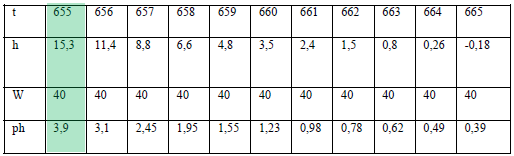
The input data for Math modeling is:

Horizontal speed: Wz=40 m/s;

Desired vertical speed in touchdown point (point where h=0): phz=0.5 m/s;

Initial trajectory slope angle in radians: γ0 =0.097;

Flare beginning height: hz=15 m.

Flare begins at the moment: t=655 s.

The trajectory slope angle change from the flare beginning by the height change law, the vertical speed change law and the flare period equation.


FROM INPUT DATA

Height and vertical speed calculation


The first method provides more accurate touchdown.

It is the fixation of touchdown point and altitude exponential step change.

THIRD CASE STUDY: James Albright

A G450’s flight path vector at 10 ft. on a short runway (KBED Runway 23). By James Albright.


“I find that raising my eyes to the end of the runway, but below the horizon, does the trick. The photo shows the flight path vector (symbology that shows the aircraft’s trajectory) slightly below the end of the runway because I was looking at the runway’s end, not the horizon. If I sense the airplane has leveled off, I’ll nudge the stick forward with the thought, “Keep it coming down.” This assures the aircraft continues to descend. Even without flight path vector technology, the pilot needs only to shift his or her eyes to the end of the runway to keep the descent rate going. But there is a little more to it than that, and for that we need to look at some timing.”

G650’s flare path starting at 25 ft

When we begin the flare, the MLG will be at 25 ft. and the pilot’s eyes 14.5 ft. higher. The aimpoint will be 39.5 ft. / tan(3deg.) = 754 ft. away. Since the MLG have to travel an additional 42 ft., we know the distance of the flare will be a total of 796 ft. If we assume a ground speed of 120 kt., the flare will take:


The flare can be learned scientifically by instilling the need to begin at a consistent height, pulling back at a consistent rate, and with your eyes pointed at the end of the runway. Each event should be graded looking for a 4-sec. rotation to flare, ending with the wheels touching at the desired aimpoint.


How to Land an Airplane, in Summary

(1) Fly a stable approach, on speed, on the proper glidepath.

(2) Cross the runway threshold at 50 ft. visually or electronically. Remember that if flying visually or on an ILS glideslope, your wheels will be lower than 50 ft. (In our example, that was 35.5 ft. when flying visually.)

(3) Determine the proper flare height based on any flight manual data or on what you have determined by experience. This height can be made evident by electronic means, such as a radio altimeter, but should always be backed up with a point on the runway that you expect to just disappear under the nose. (In our example, a point 600 ft. short of the aimpoint.)

(4) At the proper flare height, shift your eyes to the end of the runway (not the horizon), and using one smooth and continuous motion, pull back to your flare rotation pitch. The pull should take 4 sec. and should end as the wheels touch with the aircraft still in a 100- to 200-fpm descent rate.

Notice that we have not mentioned thrust at all, which will be handled in accordance with aircraft-specific procedures. My technique is to allow the autothrottle “retard” function, if available, to function as designed. This further reduces the number of variables. If operating without autothrottles, I attempt to initiate the reduction at the same time I initiate the pitch rotation, reaching idle as the wheels touch. This has worked on every aircraft I have flown, but I recognize it will not work for others.

One last note for those flying aircraft with unpublished eye-to-wheel and flare heights. The math shown here is for a Gulfstream G650, an aircraft in the 100,000-lb. range that is nearly 100 ft. long. Using a 25-ft. flare height will probably be conservative for smaller aircraft but will give you a starting point. (Remember larger aircraft may have flare heights around 30 ft.) I recommend trying these out in the simulator or seeing what you have been doing in the airplane as a comparison. The first step in any scientific endeavor is observation. I believe you can improve your landings if you approach the landing flare as science, not art.

Factors that may require an earlier flare

Flare should be initiated at around:

30 ft RA (A220/A300/A310/A320) or

40 ft (A330/A340/A350/A380) in stabilized conditions.

“The PF must avoid forward stick inputs once flare is initiated.”

Any forward stick input after flare is initiated will increase the risk of landing on NLG with hard impact.

The PF must start the flare with a positive and prompt back pressure on the control column to break the descent rate. The PF must then maintain a constant and positive back input on the control column until touchdown.


Retard! Retard! Retard! Retard!

For A320/A330/A340/A350/A380 aircraft

The 20 ft “RETARD” auto callout is a reminder, not an order. The PF can retard the thrust levers earlier or later depending on the conditions.

The PF must ensure that the thrust levers are at idle in any case, by touchdown at the latest, to enable automatic extension of the ground spoilers.”

In the case of a bounce - Maintain the aircraft pitch


HIGH BOUNCE

·         Maintain pitch

·         Apply go-around thrust

·         Counteract any pitch-up tendency (because of THRUST INCRESE. That will avoid TAILSTRIKE).